
This self reflection activity is an opportunity for you to engage and focus with complex academic material. You may attempt the activity as many times as you choose.
The Intersection of Emotion and Cognition
Quiz Summary
0 of 2 Questions completed
Questions:
Information
You have already completed the quiz before. Hence you can not start it again.
Quiz is loading…
You must sign in or sign up to start the quiz.
You must first complete the following:
Results
Results
0 of 2 Questions answered correctly
Your time:
Time has elapsed
You have reached 0 of 0 point(s), (0)
Earned Point(s): 0 of 0, (0)
0 Essay(s) Pending (Possible Point(s): 0)
Categories
- Not categorized 0%
- 1
- 2
- Current
- Review
- Answered
- Correct
- Incorrect
-
Question 1 of 2
1. Question
The diagram below and it’s annotation (Fig 1) is taken from Immordino-Yang and Damasio’s 2007 paper “We Feel Therefore We Learn: The Relevance of Affective and Social Neuroscience to Education.”
Spend a few moments reading and processing the diagram before answering the self-reflection questions below.
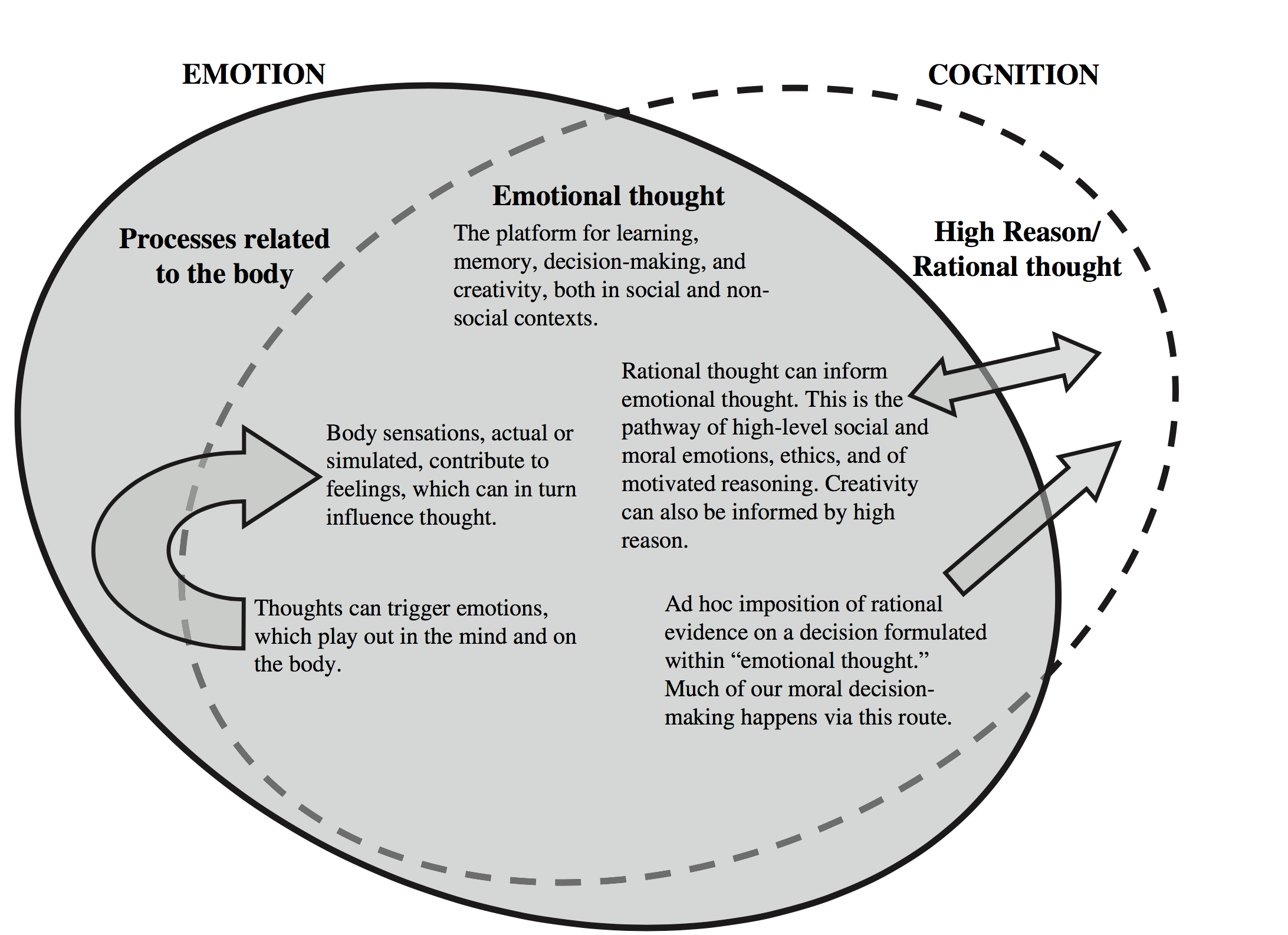
Fig 1. The evolutionary shadow cast by emotion over cognition influences the modern mind. In the diagram, the solid ellipse represents emotion; the dashed ellipse represents cognition. The extensive overlap between the two ellipses represents the domain of emotional thought. Emotional thought can be conscious or nonconscious and is the means by which bodily sensations come into our conscious awareness. High reason is a small section of the diagram and requires consciousness-
In the diagram shown, Emotional Thought is at the intersection of Cognition and . Emotional Thought is described to be the platform for , , and both in social and non-social contexts.
CorrectIncorrect -
-
Question 2 of 2
2. Question
Match the phrases with the most appropriate description:
Sort elements
- can inform emotional thought. This is the pathway of high-level social and moral emotions, ethics and of motivated reasoning.
- can be informed by high reason
- actual or stimulated, contribute to feelings which can in turn, influence thought
- can trigger emotions which play out in the mind and on the body.
- combine to form emotional thought
-
Rational Thought
-
Creativity
-
Body sensations
-
Thoughts
-
Emotion and Cognition
CorrectIncorrect